How Much Should You Plan Before a Solo Trip?
Quick Answer: Lock down four things and leave the rest open: arrival logistics for day one, all accommodation for the first three nights, one anchor activity per day, and anything that genuinely sells out. That is roughly 30 percent planned. The failure mode is not too little or too much planning in general — it is planning the wrong parts. Over-planned itineraries collapse on contact with reality; under-planned trips fail specifically on arrival day and around dinner time.
You have a spreadsheet with hourly slots, or you have a flight booking and a vague sense of optimism. Both of these are going to cause you problems, and they will cause them at completely different points in the trip.
Here is what actually distinguishes a well-planned solo trip: not the amount of planning but its distribution. The parts that need to be locked are surprisingly few, and the timing detail in the third section is what separates a good first day from a miserable one.

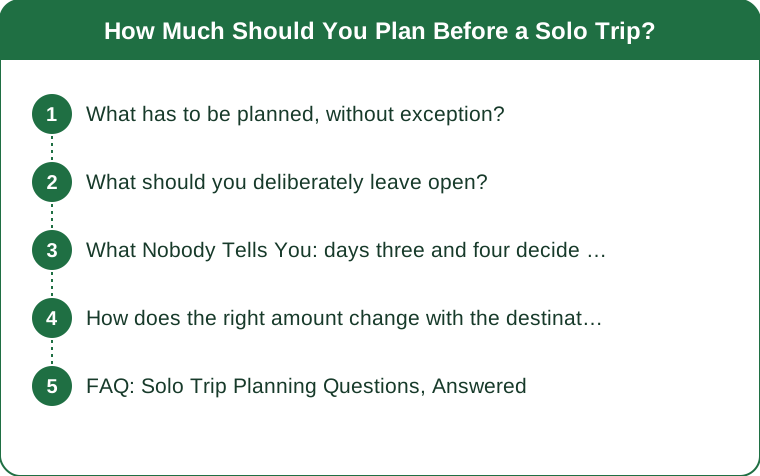
What has to be planned, without exception?
Arrival day, in detail
This is the highest-value planning you will do and the part most under-planners skip. Arrival day is when you are most tired, least oriented, and least capable of making good decisions, and it is also when the highest number of decisions is required.
Specifically: how you get from the airport or station to your accommodation, written down, with a backup. The address in the local language, saved offline. What time you can check in, and what you do if you arrive before that. One place to eat that first night, chosen in advance.
That last one matters more than it sounds. The first solo dinner is consistently reported as the hardest moment of a trip, and deciding where to go when you are jetlagged and unsure is exactly when it feels worst. Having a place already picked turns a decision into an errand.
The first three nights of accommodation
Non-negotiable. After that you can improvise if you want to — but not from the start, when you have no local knowledge and no energy.
One anchor per day
A single thing that gives the day a shape: a museum, a hike, a neighborhood to walk, a class. Not a schedule — an anchor. Everything else assembles itself around it.
Anything that genuinely sells out
Timed-entry attractions, popular tours, long-distance trains in peak season, restaurants that book weeks ahead. If it cannot be done on the day, book it. If it can, do not.
The boring safety layer
Someone at home with your itinerary. Travel insurance. Copies of documents stored somewhere you can reach without your phone. Registered with your country’s travel service if it offers one. Fifteen minutes, once, and it never needs thinking about again.
What should you deliberately leave open?
Almost everything else, and specifically these.
Daily schedules beyond the anchor. An hourly itinerary is a machine for producing guilt. You will not walk as fast as you think, you will find something you did not plan for, and the whole structure falls over by 11am on day two — after which you are behind on your own holiday.
Restaurants beyond arrival night. Booking every dinner in advance means you eat where past-you decided instead of where you actually are and what you actually want.
Transport between cities, if the routes are frequent. Fixing yourself to a 7am train on day five removes your ability to stay somewhere you are enjoying. Where trains or buses run hourly and prices do not spike, buy on the day.
The back half of the trip. Many experienced solo travelers plan the first half properly and leave the second half loosely sketched, because what you want on day seven is not knowable on day one.
Every hour of your one rest day. Build at least one genuinely unscheduled day into any trip over five days. Not a day for the things that did not fit — an actually empty day.

What Nobody Tells You: days three and four decide the trip
There is a shape to solo trips that almost nobody plans for.
Days one and two run on novelty. Everything is new, you are busy orienting, and the adrenaline covers a lot.
Days three and four are where it turns, in one direction or the other. The novelty has worn off, you have made every decision alone for 72 hours, and the accumulated weight of small choices — where to eat, which way to walk, whether to talk to anyone — starts to register as tiredness that sleep does not fix.
This is decision fatigue, and it is the actual reason solo trips go flat. It is not loneliness in the way people expect. It is the cognitive cost of having nobody to split the choices with.
Three things that address it directly:
Front-load the structure into days three and four, not days one and two. Put your booked tour, your cooking class, or your day trip there — anything where somebody else decides what happens next. It is a rest for a part of your brain you did not know was working.
Reduce your decision surface deliberately. Eat breakfast at the same place every morning. Establish a small routine. Solo travelers who do this consistently report better trips than those who optimize every meal.
Plan one social touchpoint in that window. A walking tour, a hostel dinner, a class. Not because you need friends, but because a couple of hours of conversation resets something that solitude alone does not.
There is a seasonal note worth adding right now. Shoulder season travel — late summer into autumn — is easier logistically and lonelier socially. Fewer crowds, better prices, more availability, and noticeably fewer other travelers to fall into conversation with. If you are traveling in the next couple of months, weight the social planning slightly heavier than you would in July.
How does the right amount change with the destination and the traveler?
Plan more when: it is your first solo trip, the language is one you do not speak at all, the destination has limited infrastructure, you are traveling in high season, or you have a fixed short window and specific things you want to see.
Plan less when: you have traveled solo before, the destination is well-connected, you speak the language or English works widely, you have more than ten days, or the trip is explicitly about rest rather than sightseeing.
A useful calibration for a first solo trip: roughly 50 percent planned rather than 30. The extra structure is worth the lost spontaneity while you are learning what you actually like doing alone. You will plan less next time, from experience rather than principle.
One tool worth more than any itinerary: a shortlist rather than a schedule. Ten things you might want to do in the destination, unordered and unassigned to days. Each morning you look at the list and the weather and pick one. You get the benefit of research without the tyranny of a timetable, and nothing is ever behind schedule because there is no schedule.
FAQ: Solo Trip Planning Questions, Answered
How far in advance should I book flights and accommodation?
Flights, one to three months out for most destinations. Accommodation for the first few nights as soon as the flight is confirmed, particularly in shoulder and high season when the good centrally located options go first. Beyond the first three nights, a few days ahead is usually plenty outside of peak periods and major events.
Should I book a tour for the first day?
A half-day walking tour on day one or two is one of the highest-return bookings in solo travel. You get oriented, you get local context, and you get a couple of hours of conversation at exactly the point when you have not spoken to anyone in a while. It is worth doing even if you normally dislike organized activities.
What if I plan nothing at all?
You will spend a meaningful share of your trip making logistical decisions instead of experiencing the place, and the arrival day will be genuinely unpleasant. Complete spontaneity works for experienced travelers in familiar regions with long timelines. For everyone else it converts a holiday into an admin task.
TL;DR:
- Lock four things: arrival day logistics, three nights of accommodation, one anchor per day, anything that sells out.
- Leave open: daily schedules, restaurants after night one, flexible intercity transport, and the back half of the trip.
- Front-load structure into days three and four — that is where decision fatigue lands, not day one.
- Use a shortlist instead of an itinerary. Nothing is ever behind schedule if there is no schedule.
Plan the parts where being wrong costs you a whole day. Leave the rest to the version of you who is actually standing there.
Keep Reading
This article is for general informational and styling purposes only. Fit, sizing, and product availability may vary.