How to Plan a Shoulder Season Solo Trip Without Losing Half of It to Closures
Quick Answer: Shoulder season closures are predictable if you check three things before booking: whether the specific attractions you care about publish seasonal hours, whether local transport - especially ferries, mountain lifts and seasonal buses - runs on a reduced timetable, and whether the destination’s tourist infrastructure is seasonal or year-round. Coastal and mountain destinations close hardest; cities barely notice. Check the actual dates on official sites rather than assuming, since seasonal end dates vary by a fortnight or more year to year.
You got the flights for half price and the hotel for a third.
Then discovered the ferry you built the whole itinerary around stopped running four days earlier.

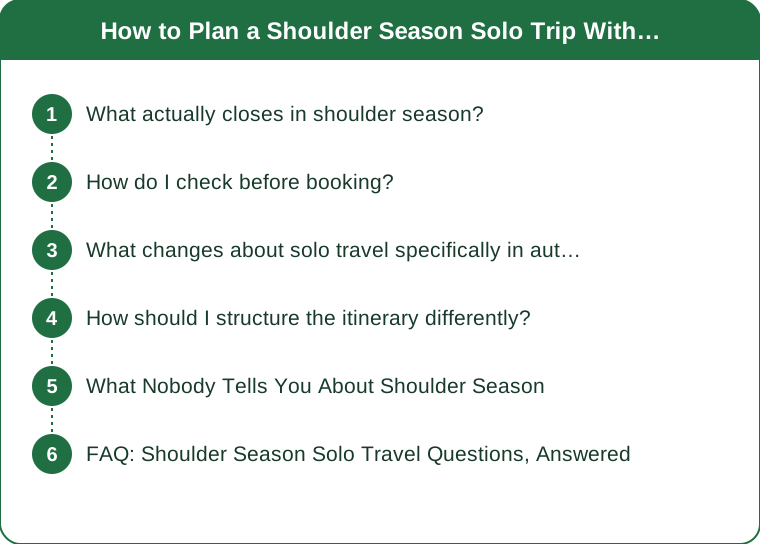
What actually closes in shoulder season?
Seasonal transport, first and most disruptively. Ferries, mountain lifts, seasonal bus routes and tourist trains often run to a summer timetable that stops abruptly.
Small, family-run accommodation and restaurants in seasonal destinations, many of which close entirely for a month or more.
Outdoor attractions and activity operators - boat trips, guided walks, water sports and anything weather-dependent.
Some museums and heritage sites shift to reduced hours rather than closing, which is manageable but changes what fits in a day.
What stays open: cities, capitals, year-round destinations, and anywhere with a domestic population rather than only tourists.
The rule of thumb: the more seasonal the destination, the harder it closes, and small islands and mountain villages are the extreme case.
How do I check before booking?
Check the official site of the specific things you care about, not aggregators, which frequently show stale hours.
Look for the phrase seasonal or the published operating dates, which most attractions state clearly if you scroll far enough.
Check transport separately and first, because a closure there breaks the whole itinerary rather than one afternoon.
Email or message ahead if the dates are borderline. A one-line question answered by an actual person is worth more than any amount of website reading, and small operators reply quickly out of season.
Search recent reviews filtered by month to see whether people visiting at the same time of year found things open.
And check local school holiday dates, since some destinations tie their seasons to those rather than to the calendar.
What changes about solo travel specifically in autumn?
Fewer other travellers means fewer casual social opportunities, which is either the appeal or the drawback depending on why you are going.
Hostels and social accommodation may be quiet or closed, so if meeting people matters, choose destinations with a year-round travel scene.
Group tours and activities may not run with insufficient numbers, which is worth checking rather than assuming.
Daylight is shorter, which compresses sightseeing days and changes when you would want to be walking back to accommodation.
Weather is more variable, so a flexible itinerary is more valuable than a tightly booked one.
And the upsides are substantial: lower prices, actual availability, restaurants with tables, and the experience of places as they are rather than as they are in August.

How should I structure the itinerary differently?
Fewer destinations, longer stays. Shoulder season transport is less frequent, so hopping between places costs more time than it does in summer.
Build in weather days. Plan indoor alternatives for at least a couple of days rather than assuming the forecast.
Book accommodation with flexible cancellation, which is usually cheap out of season and lets you adapt.
Front-load the outdoor plans, since the season only gets later and the weather only gets more variable as the trip progresses.
Check sunset times for your dates, which people consistently forget and which meaningfully changes how much a day holds.
And keep one full day unplanned, which is the single best piece of advice for any solo trip and is easier to honour when nothing is fully booked.
What Nobody Tells You About Shoulder Season
Closing dates vary by more than you would expect. The same restaurant that closed on 15 October last year might close on 1 October this year depending on how the season went. Published dates are intentions, not promises, and checking a week before travel is worth doing again.
The first week after the season ends is the worst timing available, because everything closes at once and the weather has not yet become properly autumnal. Either go a week earlier and get the tail of the season, or go a month later and get a genuinely different, quieter experience.
Reduced transport frequency is more disruptive than closures. A museum being shut costs an afternoon; a bus running twice a day instead of eight times restructures your entire trip.
Small towns can be genuinely empty, which some people find wonderful and others find isolating. If you are travelling alone and hoping for atmosphere, a small seaside town in November may be quieter than you pictured.
Prices drop unevenly. Flights and hotels fall sharply; car hire, taxis and food often do not, because the local cost base does not change. Budget accordingly rather than assuming everything is cheaper.
Some destinations are actually better out of season in a way that is not just about crowds - cities with hot summers become pleasant, and popular hiking areas become comfortable rather than punishing.
And travel insurance matters more, because weather disruption, cancelled transport and changed plans are all more likely. Check that your policy covers the specific activities you are planning.
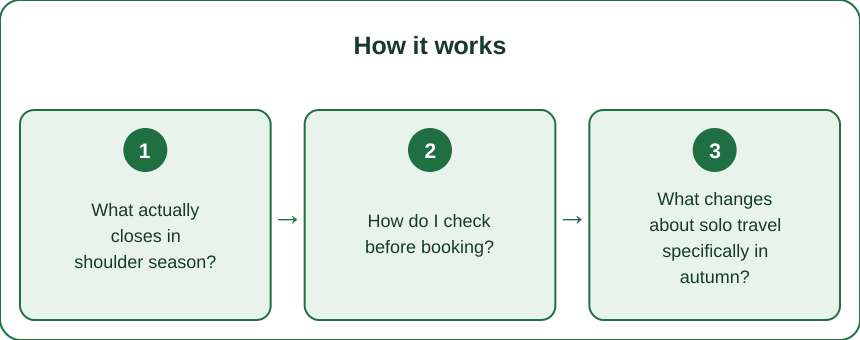
FAQ: Shoulder Season Solo Travel Questions, Answered
When exactly is shoulder season?
It varies by destination, but broadly the weeks either side of the peak season - often late April to early June and September to October in the northern hemisphere. Check the specific destination, since it can differ by a month.
Which destinations close hardest?
Small islands, coastal resorts, mountain villages and anywhere whose economy is almost entirely seasonal tourism. Cities and destinations with a year-round local population barely change.
Is it safe to travel solo out of season?
Generally as safe as in season, with the difference that fewer people around means less passive company. Standard precautions apply - share your itinerary, keep someone updated, and be more conservative about remote areas and late walks.
How far ahead should I book?
Less far than in summer, which is one of the advantages. But book transport that has reduced frequency early, since fewer services means they fill.
Will I meet other travellers?
Fewer, and more in cities than in seasonal destinations. If meeting people is a priority, choose year-round travel hubs rather than beach towns.
What about the weather?
More variable, and this is the trade for the price and the quiet. Pack layers, plan indoor alternatives, and treat the forecast as a rough guide rather than a schedule.
Should I get travel insurance?
Yes, and check it covers weather disruption and any specific activities. Shoulder season has more disruption than peak season, which is exactly when insurance earns its cost.
TL;DR:
- Check seasonal transport first - it breaks itineraries in ways closed attractions do not.
- Verify dates on official sites, not aggregators, and re-check a week before travel.
- Coastal, island and mountain destinations close hardest; cities barely notice.
- Fewer destinations and longer stays, because transport is less frequent.
- Avoid the week immediately after the season ends - it is the worst timing available.
- Flights and hotels drop sharply; food, taxis and car hire often do not.
The quiet version of a place is usually the better one, as long as you can still get there.
Keep Reading
This article is for general informational and styling purposes only. Fit, sizing, and product availability may vary.