How to Decide Whether to Extend or Cut Short a Solo Trip
Quick Answer: Do not make the decision on the day you have the thought. Wait 48 hours and make it in the morning, because both urges track short-term states — tiredness, a bad day, a good day, a new friendship — far more than they track how the trip is actually going. Then test it against three things: whether the reason is about this place or about being away, whether the practical cost is recoverable, and whether you would regret the version you did not choose.
The thought itself is not information.
When and why it arrived is.

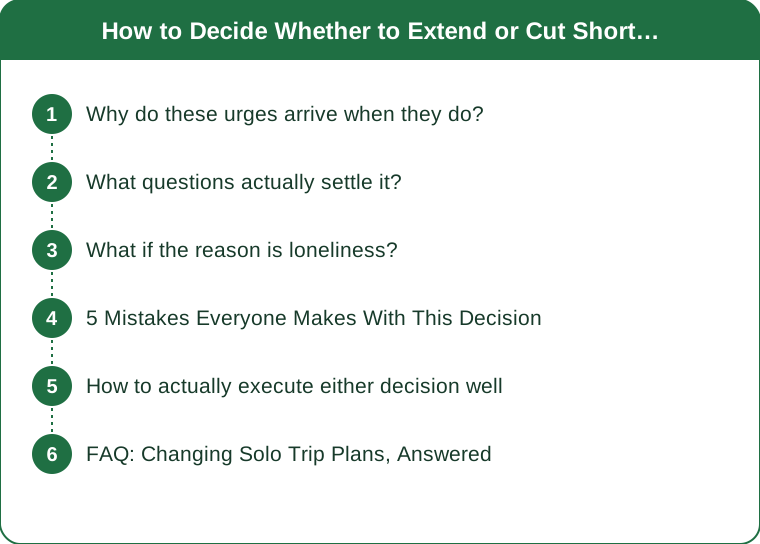
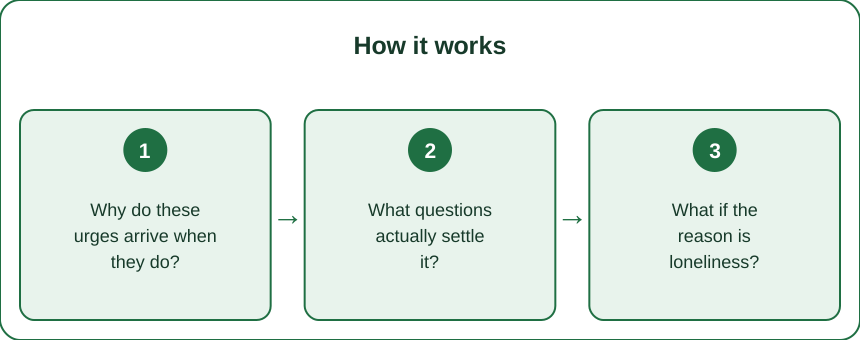
Why do these urges arrive when they do?
Because solo trips have a fairly consistent emotional shape, and both impulses cluster at known points.
The urge to go home most often appears in the first two or three days and again somewhere around day seven to ten. The early version is arrival disorientation — unfamiliar everything, no routine, and the gap between the trip you imagined and the one you are in. It resolves for most people within about seventy-two hours.
The second wave is different. By day seven or so the novelty has worn off, the logistics have become tiring, and you have had enough meals alone for it to register. This one is real fatigue rather than disorientation, and it responds to changing the pace rather than to ending the trip.
The urge to extend usually comes after a good day, a good conversation, or arriving somewhere that immediately suits you. It is genuine and it is also strongly state-dependent — the same place on a rainy Tuesday with a poor night’s sleep produces no such urge.
There is a third, quieter version worth naming: the urge to extend as avoidance, when what is waiting at home is unappealing. That is worth being honest with yourself about, because it produces decisions that feel like adventure and function as postponement.
So the first move in either direction is the same: note the thought, note the day, and do nothing for 48 hours.
What questions actually settle it?
Four, in this order. They take about ten minutes with a notebook and they work better written than thought.
1. Is this about the place or about being away?
If you are unhappy with the destination — wrong season, wrong fit, not what the photographs suggested — that is a solvable problem and the solution is usually to move rather than to go home. If you are unhappy being away from home generally, moving will not fix it and going home might be right.
2. What specifically would make the next three days better?
If you can name something — a different town, a day of doing nothing, a hotel instead of a hostel, one activity with other people — do that first and reassess. A remarkable share of go-home urges are solved by a decent night’s sleep in a private room.
3. What is the recoverable cost of each option?
Money, missed commitments, changed flights, someone waiting for you. Be concrete. People routinely overestimate the cost of changing plans and underestimate the cost of four more miserable days.
4. Which version will I mind more in a month?
The honest test. Not which is more virtuous — which one you will still be thinking about. For most people, cutting short a trip that was going badly barely registers a month later, while ending a trip that was going well tends to linger.
If all four point the same way, you have your answer. If they conflict, default to staying two more days and asking again — the cost of that is almost always low.
What if the reason is loneliness?
Then treat it as the specific and solvable thing it usually is, before treating it as a verdict on the trip.
Solo travel loneliness is not evenly distributed. It concentrates heavily around evenings, meals and unstructured time, and particularly around the first hour after dark. Knowing that pattern is most of the fix, because it tells you where to intervene.
Things that work, roughly in order of effectiveness:
Change your accommodation type for two nights. A social hostel, a guesthouse with a common area, or a place with a communal breakfast will change your daily contact count more than anything else you can do.
Book one structured group thing. A walking tour, a cooking class, a day trip. Structured contact is far easier than spontaneous contact and it reliably produces conversation.
Eat your main meal at lunch. Lunch alone is socially unremarkable and dinner alone is the hard one for most people. Simply shifting the big meal earlier removes the difficult hour.
Sit at a bar or counter rather than a table. Counters are conversational by design and they remove the visible table-for-one.
Call someone at home, deliberately and briefly. A scheduled twenty-minute call is very different from scrolling through everyone’s evening on a phone, which reliably makes it worse.
And a seasonal note that catches a lot of people out: as it starts getting dark at five, the lonely part of the day gets several hours longer without anything else changing. Shoulder-season travel is quieter and cheaper and it genuinely has more evening in it. If your trip suddenly feels harder and nothing else has changed, check the sunset time before you conclude anything about the trip.

5 Mistakes Everyone Makes With This Decision
1. Deciding at night. Almost every impulse in both directions is stronger after dark and weaker at nine the next morning. Making the call in the evening is the single most common way people end up regretting it.
2. Deciding on a travel day. Moving between places is tiring, disorienting and often involves something going wrong. It is the worst possible sample of how a trip is going, and it is when a surprising number of people book flights home.
3. Treating the original plan as a commitment. You made it months ago with less information than you have now. Changing it is not a failure of resolve — it is using information you did not previously have.
4. Extending without changing anything. If you extend in the same place, in the same accommodation, with the same routine, you will typically get diminishing returns and then the go-home urge anyway. Extending works when it comes with a change of pace or place.
5. Not telling anyone either way. The step nearly everyone skips — saying it out loud to one person at home turns a spiralling internal debate into a two-minute conversation, and it is remarkable how often the act of explaining your reasoning to someone else reveals which option you had already chosen.
How to actually execute either decision well
Practical steps, because a good decision executed badly costs more than it should.
If you are cutting it short:
Check the change fees before you commit emotionally. Flexible fares, airline change policies and the cost of a new one-way vary enormously. Get the actual number.
Consider a partial version. Coming home four days early is different from abandoning the trip. So is moving to somewhere easier for the remaining days, or spending the last stretch in one place instead of three.
Cancel accommodation promptly. Free-cancellation windows are usually 24 to 48 hours and letting them lapse converts a decision into a cost.
Do not narrate it as a failure. You went, you found out something about how you travel, and you made a call. That is a reasonable use of a trip.
If you are extending:
Check your visa or entry conditions first, before anything else. This is the one that genuinely traps people, and the rules on permitted stay are not flexible.
Check insurance dates. Travel insurance ends on a specific day and extending beyond it leaves you uncovered, which is precisely when it matters.
Tell whoever is expecting you. Employers, flatmates, whoever is feeding your cat.
Change something about the trip, not just its length. A new place, a slower pace, a different type of accommodation. Extending the same days rarely produces more of what made you want to extend.
Rebook rather than winging it if it is a busy season. Shoulder season has more availability and more closures, which is its own planning problem.
FAQ: Changing Solo Trip Plans, Answered
How long should I give it before deciding?
Forty-eight hours for a general feeling, and longer if you are in the first three days — arrival disorientation is extremely common and it usually resolves on its own by day four.
Is wanting to go home early a sign solo travel is not for me?
Not on its own, and particularly not on a first trip. Most experienced solo travellers report having had the urge, often more than once. What it more often signals is that the trip was too long, too fast, or too unstructured for how you like to travel.
What if I extend and then regret it?
You go home. Extending is not a commitment either — the flexibility runs in both directions and people forget that. The cost is money rather than anything irreversible.
Should I tell people at home I am struggling?
Generally yes. The instinct to present a good trip is strong and it isolates you further. One honest conversation usually helps more than several cheerful ones.
Is it cheaper to change flights or book a new one?
Entirely depends on the fare type and the route. Check both, and check whether your travel insurance or credit card covers any change costs, which people frequently forget.
What if the trip is fine but I am just bored?
Boredom on a solo trip usually means the pace is wrong rather than the trip. Either too much moving — which is exhausting and prevents you settling — or too little. Changing the rhythm fixes it more reliably than changing the length.
TL;DR:
- Both urges track short-term states, so wait 48 hours and decide in the morning, never at night or on a travel day
- Ask whether the problem is this place or being away — the first is solvable by moving, the second is not
- Loneliness concentrates around evenings and meals; changing accommodation type and eating your main meal at lunch both help
- If you extend, change the pace or the place too, and check visa and insurance dates before anything else
- Saying it out loud to one person at home usually reveals which option you had already chosen
If you are having the thought right now, write down the four questions and answer them in the morning. Almost nobody regrets waiting two days, and a lot of people regret the flight they booked at eleven at night.
Keep Reading
This article is for general informational and styling purposes only. Fit, sizing, and product availability may vary.