How to Actually Make Friends While Traveling Solo (Without Forcing It)
Quick Answer: Hostels with active common areas, free walking tours, and cooking or activity classes are the highest-success spots for meeting people naturally, since everyone there already showed up wanting the same social interaction. Skip forced small talk and instead ask specific, easy questions tied to the shared activity in front of you.
Most solo travel advice focuses on handling loneliness after it hits. Less gets said about actually being proactive about meeting people in the first place — which, it turns out, follows a pretty reliable pattern once you know where to look.
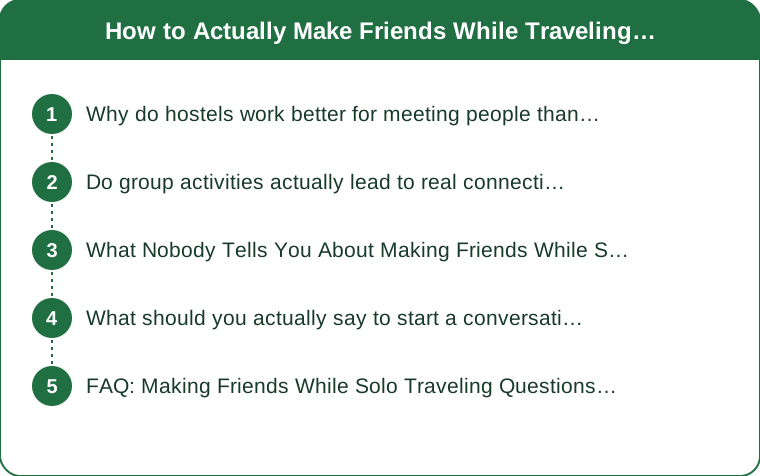
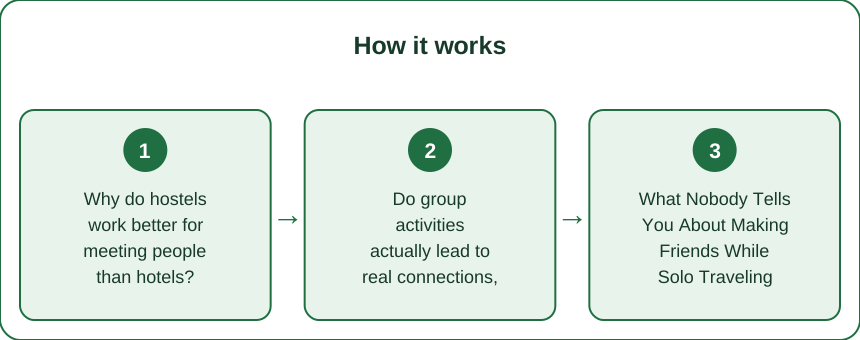
Why do hostels work better for meeting people than hotels?
It’s not really about the price point — it’s about shared intent. Everyone staying in a hostel common area or communal kitchen has, on some level, opted into a more social environment, which makes striking up conversation far less awkward than approaching a stranger in a hotel lobby who’s specifically there for privacy.
Even if you’re not on a tight budget, booking one or two nights in a social hostel specifically for the common area energy — while staying elsewhere for the rest of your trip — is a reasonable strategy purely for the social benefit.
Do group activities actually lead to real connections, or just surface small talk?
Free walking tours, cooking classes, and small-group day trips work well specifically because they give you something to talk about besides small talk — you’re both reacting to the same guide, the same dish, the same view, which gives conversation a natural starting point instead of the harder work of generating topics from scratch.
The connections that actually go somewhere (grabbing dinner afterward, exchanging contact info) tend to happen when the activity itself creates a few genuine shared moments, not just proximity. A 3-hour walking tour does this far better than sitting near someone at a cafe.

What Nobody Tells You About Making Friends While Solo Traveling
Here’s what surprises a lot of first-time solo travelers: you often have to be the one who suggests the next step, even if a conversation went really well. Other travelers are frequently just as unsure whether to suggest grabbing dinner together as you are — someone has to say ‘want to grab food after this?’ out loud, and it might as well be you.
Another thing people don’t expect: the friendships that form while traveling can feel unusually fast and close, precisely because everyone involved is more open and has more free time than in regular daily life. Don’t second-guess a connection just because it happened quickly — that’s normal for travel, not a red flag.
What should you actually say to start a conversation without it feeling forced?
Specific, situational questions work far better than generic ones. ‘Where are you headed after this?’ or ‘Have you found anywhere good to eat around here?’ gives the other person an easy, concrete thing to respond to, compared to a vague ‘so, traveling alone too?’ that can feel like it’s fishing for something.
Common spaces with a built-in reason to be near someone — a communal kitchen while cooking, a shared table at breakfast, a line for a tour — remove the awkwardness of approaching someone with no context at all.
FAQ: Making Friends While Solo Traveling Questions, Answered
Are travel apps for meeting other solo travelers actually worth using?
Many solo travelers find them genuinely useful, especially in destinations with less built-in social infrastructure than hostels — they work best combined with in-person spots, not as a total replacement.
What if I’m naturally introverted — does this still work for me?
Yes, though you might lean more toward smaller, activity-based settings (a cooking class over a large group party) where conversation has a natural structure rather than open-ended mingling.
Is it awkward to ask someone for their contact info after a short interaction while traveling?
Not in a travel context — it’s an extremely normal, expected part of the culture around solo travel, and most people are happy to exchange information even after a relatively brief conversation.
TL;DR:
- Hostels with active common areas and group activities have the highest natural social success rate
- Shared activities give conversation a built-in starting point better than generic small talk
- Be willing to suggest the next step yourself — everyone else is often just as unsure
- Fast, close travel friendships are normal, not a red flag
You don’t need to force it or fake extroversion — you just need to put yourself in the handful of spots where meeting people is the whole point.
Keep Reading
This article is for general informational and styling purposes only. Fit, sizing, and product availability may vary.