Why Shoulder-Season Solo Travel Is Easier and Lonelier at the Same Time
Quick Answer: Shoulder season delivers lower prices, thinner crowds, and better weather at most destinations — and simultaneously removes the dense backpacker and traveler social infrastructure that makes summer solo trips easy to meet people in. The trip gets better and the connection gets harder in the same move. Plan the social side deliberately rather than assuming it will happen the way it did in July.
Everything about the destination is better in October. The hostel common room is also empty at 8pm. Both of those are the same fact.
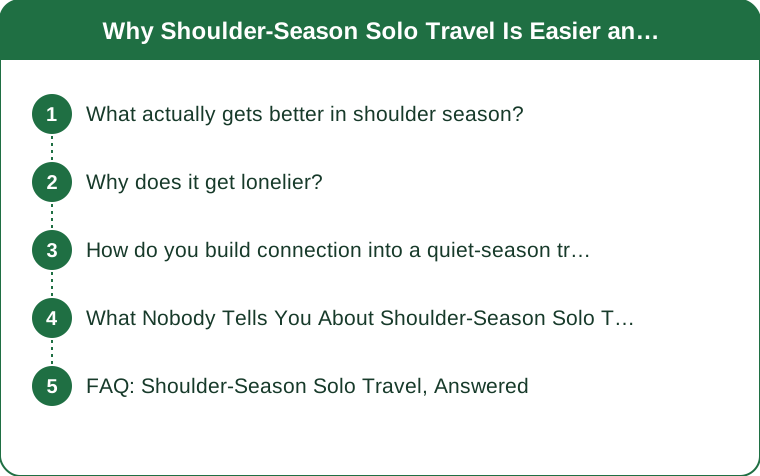
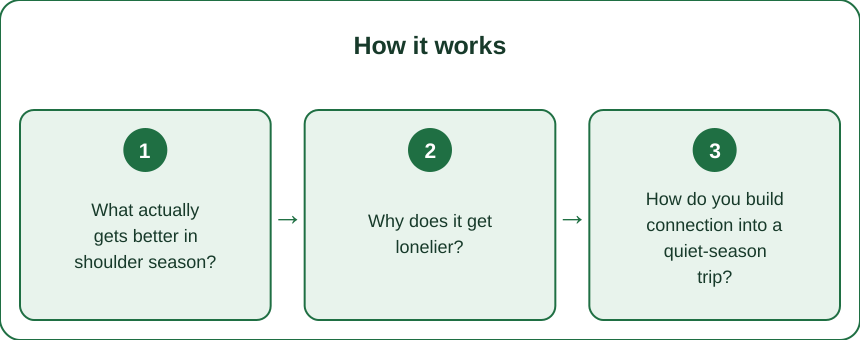
What actually gets better in shoulder season?
Almost everything about the destination itself, and by more than the price difference suggests.
Crowds thin dramatically. Sites that require timed tickets and hour-long queues in July are often walk-up in late October. This changes the experience qualitatively, not just logistically — you can stand in a room and actually look at it.
Prices drop across the board. Flights, accommodation, and tours all fall, frequently 30 to 50 percent from peak. For a solo traveler paying single-occupancy rates, this closes a meaningful part of the gap that makes solo travel more expensive per person.
Weather often improves. Many popular summer destinations are genuinely uncomfortable in peak season. Southern Europe, much of Asia, and the American Southwest are all more pleasant in October than in August.
Locals are more available. After a heavy tourist season, service staff and shop owners have more time and considerably more patience. Conversations that are impossible in August happen easily in October, and this is an underrated part of what makes shoulder-season travel rewarding.
Booking flexibility returns. You can decide where to go tomorrow rather than three weeks out, which is one of the real pleasures of solo travel and one that peak season removes entirely.
Why does it get lonelier?
Because the traveler social infrastructure is a density effect, and density is exactly what drops.
Hostel common rooms need a critical mass. In July, a common room has fifteen people and conversation happens without anyone initiating it. In October it has four, and three of them are on laptops. The same room, the same design, a completely different social outcome.
Group tours and activities get cancelled. Walking tours, day trips, and cooking classes often require minimum numbers. In shoulder season the ones that run are the large operators, and the small, sociable ones cancel — which are precisely the ones where you’d have met someone.
The solo travelers who are around are different. Peak season draws a lot of first-time and short-trip travelers who are actively looking for company. Shoulder season skews toward longer-term travelers, remote workers, and people who chose the season specifically for quiet. Many of them are excellent company and none of them are looking for it as actively.
Darkness arrives earlier and changes evenings. In northern destinations especially, an evening that started at 9pm in July starts at 6pm in October, and it’s more likely to be indoors and quieter. Evening is when solo travel loneliness concentrates, and shoulder season makes evenings longer.
The honest framing
This isn’t a reason to avoid shoulder season. It’s a reason to treat the social side as something you plan rather than something the season provides.
How do you build connection into a quiet-season trip?
By replacing incidental density with deliberate structure. Five things that work.
Book activities that run regardless of numbers. Cooking classes with a fixed schedule, established walking tours from large operators, and language exchanges tend to run in shoulder season. Small independent tours are the ones that cancel. Check the operator’s size before booking if the social element matters to you.
Stay somewhere with a genuine common space and check recent reviews for the actual season. A hostel’s summer reviews tell you nothing about its October atmosphere. Reviews from the last month do.
Use activity-based meetups rather than traveler-based ones. Local running clubs, climbing gyms, board game nights, and yoga studios run year-round because they serve residents, not tourists. These are consistently better in shoulder season than traveler-focused options, and they put you with people who actually live there.
Take the longer breakfast and the bar seat. With fewer people around, staff have time to talk, and bar seating at a restaurant converts a solo dinner into a conversation far more often in a quiet season than a busy one. This is the specific advantage shoulder season gives back — access to people who are too busy to talk in August.
Plan the evenings explicitly. Not every one, but the first two or three. An evening with something on it is qualitatively different from an evening you’ll figure out at 6pm, and the earlier darkness makes unplanned evenings harder than they were in summer.
What Nobody Tells You About Shoulder-Season Solo Travel
The loneliness arrives on a schedule. For most people it’s dinner time and the two hours after, not the daytime. Knowing that it’s situational and predictable rather than a verdict on the trip changes how it lands. Plan around that window specifically rather than trying to fix the whole trip.
Arrival day is disproportionately hard in a quiet season. In summer, the hostel absorbs you. In October you may check in and have nobody to talk to for the first eight hours. Booking one thing for arrival evening — a food tour, a class, anything — is the single highest-return planning decision of a shoulder-season trip.
Weather closures are the actual risk, not crowds. Mountain passes, ferries, seasonal attractions, and some regional transport shut down in shoulder season without much notice. Check operating seasons specifically rather than assuming things run — a trip built around something that closed on October 15th is the classic shoulder-season mistake.
Shorter days compress the sightseeing window more than you plan for. Museums closing at 5pm and dark at 6 means the usable day is genuinely shorter. Two attractions a day, not four.
Solo dining is easier, not harder, in the quiet season. Restaurants that would never seat one person at a two-top in August are happy to in October, and staff have time to be welcoming. This runs directly counter to what most people expect.
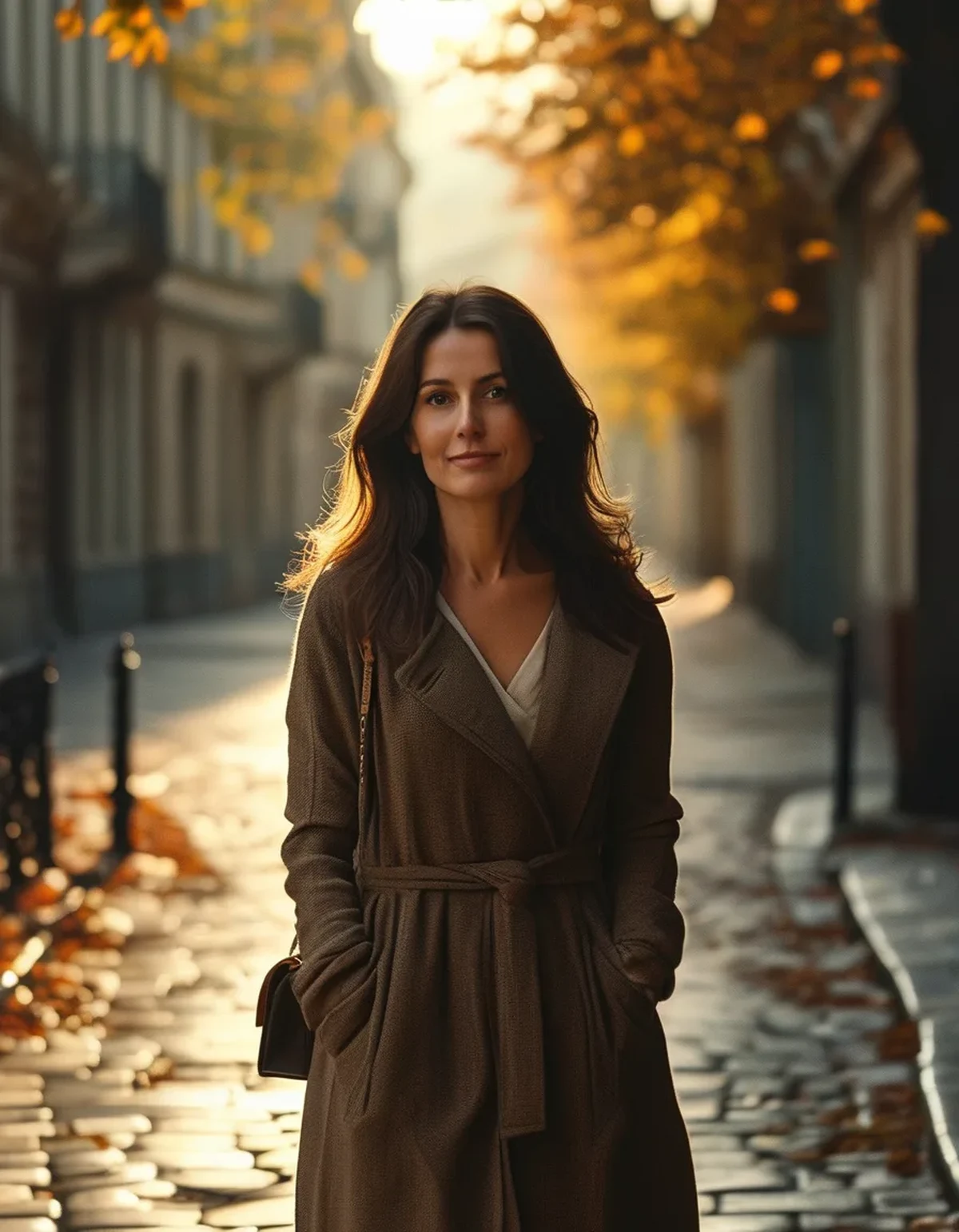
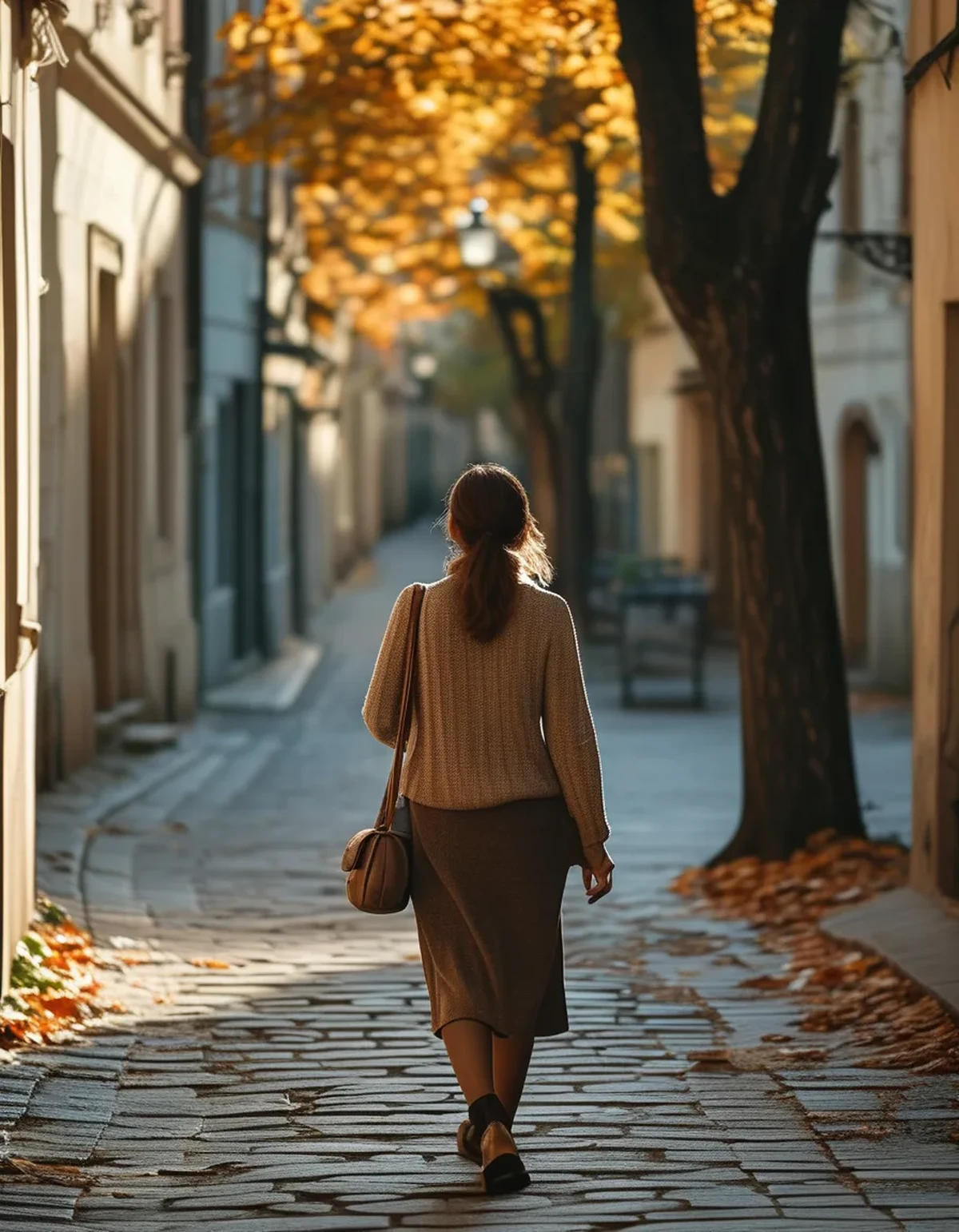
The trip photographs better. Empty streets, low golden light, and no crowds in frame. Small thing, and people consistently rate their shoulder-season photos higher afterward.
FAQ: Shoulder-Season Solo Travel, Answered
When exactly is shoulder season?
Roughly September–November and April–May for most Northern Hemisphere destinations, though it varies. Check the specific place — some have a very short window.
Is it safe to travel solo in quieter conditions?
Generally yes, with the usual precautions. Emptier streets at night warrant more attention to route choice, and it’s worth having accommodation in a livelier area rather than a purely residential one.
How do I check whether a hostel will be social in October?
Read reviews from the last four weeks only. Season-specific atmosphere doesn’t show up in aggregate ratings.
Should I book further ahead or less in shoulder season?
Less for accommodation, more for anything with a minimum group size or a seasonal closing date.
What if I’ve booked and I’m worried it’ll be lonely?
Add two structured activities in the first three days and leave the rest open. Front-loading structure works better than spreading it out.
Are prices really that much lower?
Commonly 30–50% off peak for flights and accommodation, and the gap is largest at destinations with a sharp summer season.
TL;DR:
- Shoulder season improves the destination — thinner crowds, better weather, 30–50% lower prices, more available locals
- It removes the traveler density that makes meeting people effortless in peak season
- Small sociable tours cancel; large operators and local activity groups run regardless
- Loneliness concentrates at dinner and the two hours after — plan that window, not the whole trip
- Arrival evening is the hardest slot in a quiet season; book one thing for it
- Check seasonal closures carefully — that’s the real shoulder-season risk, not crowds
The destination gets better and the social scene gets thinner. Both are true, and only one of them needs planning.
Keep Reading
This article is for general informational and styling purposes only. Fit, sizing, and product availability may vary.