Why Solo Evenings Get Harder Once It Gets Dark at Five
Quick Answer: Early darkness removes the structure that summer evenings provide for free. Daylight until nine creates a long, low-pressure window where wandering is an activity in itself; darkness at five compresses that into a choice between a planned activity and your accommodation. Solo travellers feel this far more than groups because there is no one to make the plan by default. The fix is scheduling one anchored evening activity per day before you leave the accommodation in the morning.
Shoulder-season solo travel is genuinely different from summer solo travel, and it is not just a mood.
This blog has covered why loneliness hits at specific times, why shoulder season is easier and lonelier at once, and why eating alone feels fine at lunch but awful at dinner. Early darkness is the mechanism connecting them.
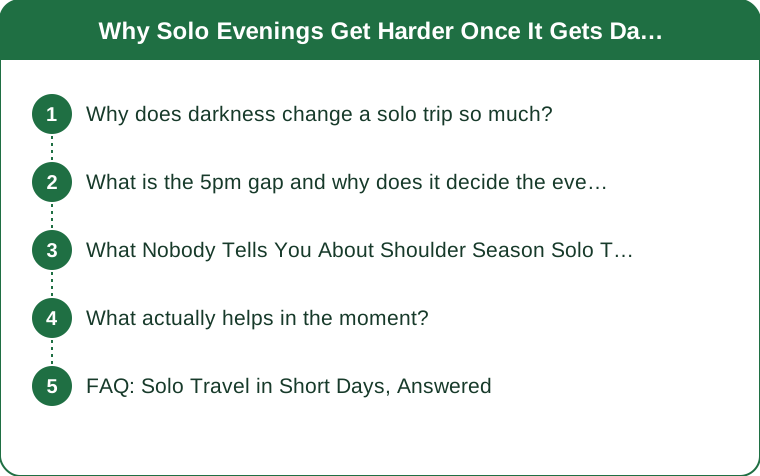
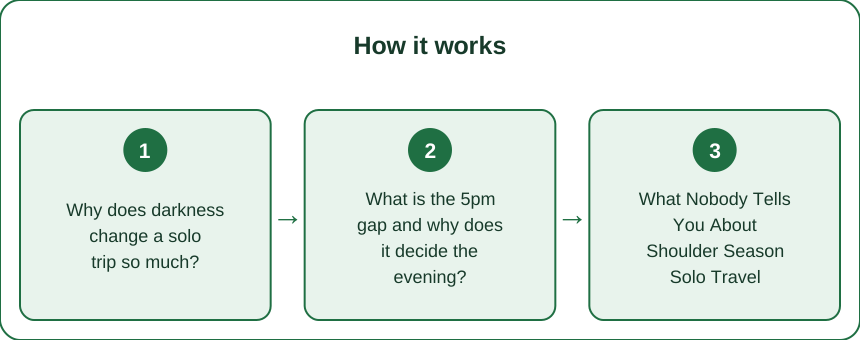
Why does darkness change a solo trip so much?
Because daylight provides free structure, and losing it exposes how much of a solo day was unplanned wandering.
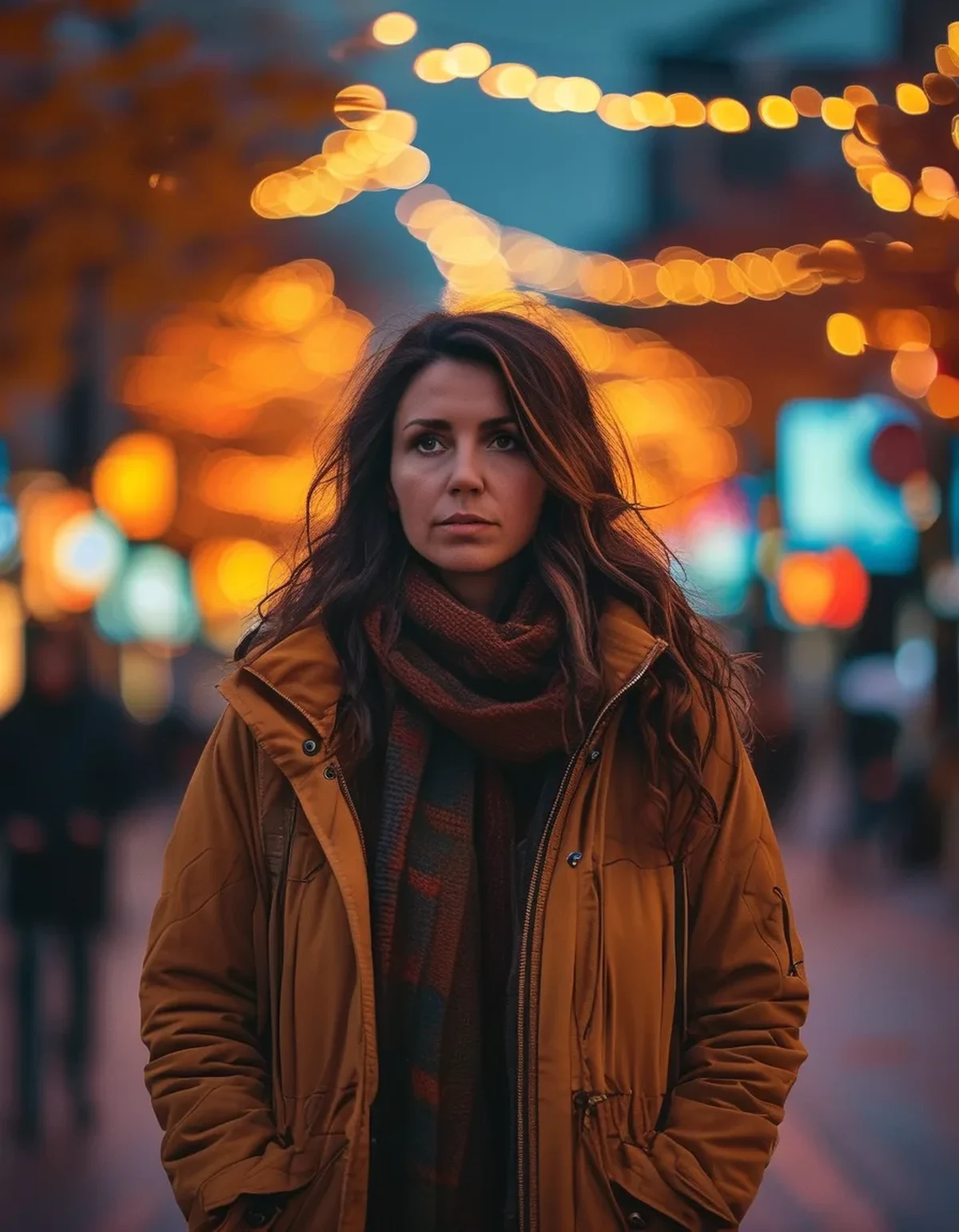
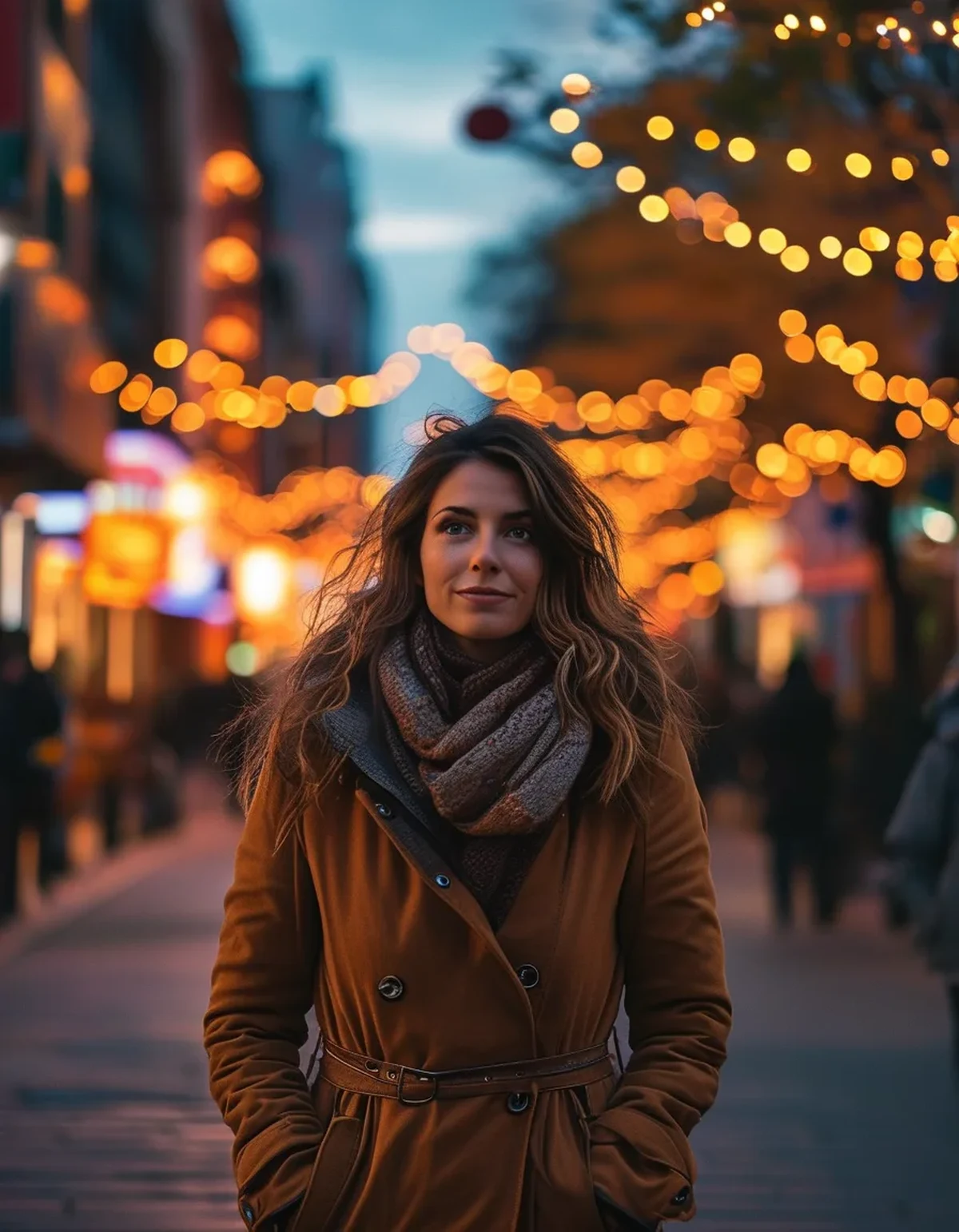
A long summer evening is an activity in itself. Walking anywhere at 7.30pm in July is pleasant, safe-feeling and self-justifying. The same walk at 7.30pm in a dark October is a decision that needs a reason.
Darkness compresses the choice set. You are effectively deciding between a specific planned activity and going back to your room, and both of those require more commitment than drifting does.
Solo travellers lose the default plan-maker. In a group, someone proposes something and the evening happens. Alone, every evening requires an active decision at exactly the point in the day when decision-making capacity is lowest.
Accommodation exerts a much stronger pull after dark. The rational-sounding thought — I’ll just drop my bag and go out again — resolves into staying in with high reliability.
Safety calculations become active in an unfamiliar city after dark, particularly for women travelling alone, and that assessment costs energy even when the answer is that everything is fine.
And the ambient social scene shifts. Summer evenings put people in public space; autumn evenings put them indoors in venues that are much harder to enter alone than a busy square is to stand in.
What is the 5pm gap and why does it decide the evening?
It is the hour between the day’s activities ending and the evening beginning, and it is where solo trips are won or lost.
Museums close, tours end, and shops start closing around five. The day’s structure genuinely stops.
You are usually tired and cold at that exact moment, which is when returning to your accommodation is most appealing and least reversible.
Restaurants are not open yet in many places, so there is no natural next thing to move toward.
Once you sit down in your room, the probability of going out again drops sharply. This is not weakness; the barrier to leaving a warm room in the dark is genuinely high.
And the evening then becomes something to get through rather than part of the trip, which is where the disproportionate loneliness comes from.
The fix is entirely structural: never return to your accommodation during that gap. A café, a bar, a bookshop, a hotel lobby — anywhere that is not your room, for one hour, changes the outcome of the evening more reliably than any amount of resolve.
What Nobody Tells You About Shoulder Season Solo Travel
It is genuinely better in most ways and harder in exactly one, and knowing which is which lets you plan around it.
Book one anchored evening thing per day, in the morning. A concert, a cooking class, a food tour, a specific restaurant with a reservation, a run club. The decision must be made before 5pm arrives, because your 5pm self will not make it.
Reserve a table for dinner rather than deciding on the night. A reservation converts a hard decision into a simple appointment, and it also removes the walking-past-restaurants-and-not-going-in problem entirely.
Move your main meal earlier. Lunch as the day’s main event and a light dinner works far better in short-daylight seasons, and lunch alone is easier than dinner alone for almost everyone.
Choose accommodation with a usable common space. In summer this barely matters; in autumn it is one of the highest-value booking criteria for a solo traveller.
Prioritise destinations with strong indoor evening culture — cities with cafés, live music, thermal baths, or a genuine evening street life. Somewhere that is a summer outdoor destination is a fundamentally different trip in November.
Front-load the day. With light from eight to five, an early start gets you a full day; a slow morning costs you a disproportionate share of it.
And accept that some evenings will be quiet, and plan for them properly. A good book, a downloaded film, and a decent room is a genuinely fine evening. The bad version is an unplanned evening spent scrolling and feeling like you are wasting the trip.
What actually helps in the moment?
Small, specific interventions rather than trying to talk yourself into feeling different.
Go somewhere warm and lit before you go back to your room. The order matters enormously.
Sit at a bar rather than a table when eating alone. Bar seating is designed for single occupancy, service is faster, and incidental conversation is available without being required.
Bring something to do that is not your phone. A book or a notebook changes the feeling of sitting alone from waiting to occupying, and it visibly signals the same thing to everyone else.
Call someone at a fixed time. A scheduled call at 6pm gives the gap a shape, and scheduled beats spontaneous because you will not initiate at your lowest point.
Walk a lit, busy route rather than a scenic empty one. Evening walking is still available; it just needs different route selection than it does in summer.
And treat the first dark evening as the hardest one. It usually is. Most solo travellers report the rhythm settling by the second or third night, provided the first one had something in it.
FAQ: Solo Travel in Short Days, Answered
Why does solo travel feel lonelier in autumn and winter?
Mainly because early darkness removes the unstructured evening wandering that summer provides for free. The choice narrows to a planned activity or your room, and solo travellers have no default plan-maker to fill that gap.
What should I do about the gap between 5pm and dinner?
Do not go back to your accommodation. Go to a café, bar, bookshop or lobby for an hour instead. The single strongest predictor of a solo evening happening at all is whether you returned to your room during that window.
Is shoulder season a bad time for solo travel?
No — it is often the best time, with fewer crowds, lower prices and more local atmosphere. The one thing it genuinely requires is booking one anchored evening activity per day, decided in the morning rather than at five o’clock.
TL;DR:
- Long summer evenings provide free structure. Darkness at five removes it and turns every evening into an active decision.
- The 5pm gap decides the night. Do not go back to your room during it.
- Book one anchored evening thing per day, in the morning, and reserve dinner rather than deciding on the night.
- Move your main meal to lunch and choose accommodation with a real common space. Both matter far more in autumn than in July.
Shoulder season is the better trip. It just needs its evenings decided before the light goes.
Keep Reading
This article is for general informational and styling purposes only. Fit, sizing, and product availability may vary.