Why You Overspend on the First Day of a Solo Trip
Quick Answer: Day one combines every condition that produces bad spending decisions at once: you are tired, you have no price reference for the city, you are near the transport hub where everything costs more, you have nobody to check a decision with, and you are buying comfort to reduce the stress of arriving. It is a predictable structural problem, not a discipline failure - which means it responds to planning rather than willpower.
Here is what drives it and the specific decisions to make before you land.

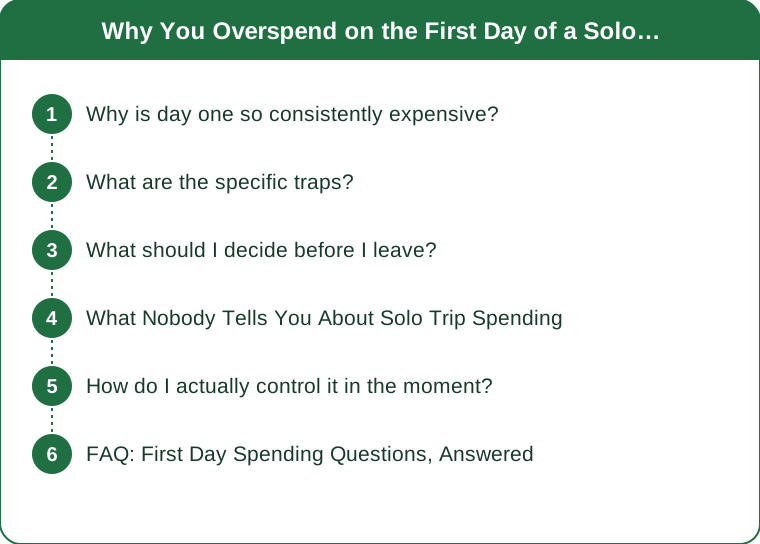
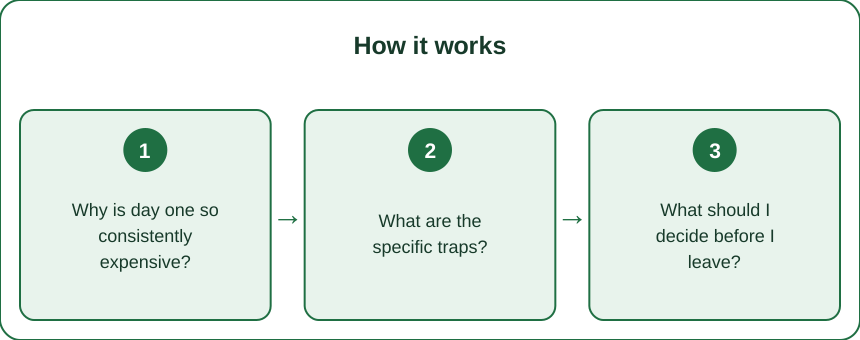
Why is day one so consistently expensive?
You have no price anchor yet. You do not know what a coffee, a taxi, or a meal should cost here. Without a reference, every price seems plausible, and the first prices you see become your baseline - which is a problem when they are airport prices.
You are physically at the most expensive point on your entire trip. Airports, stations, and their immediate surroundings charge a premium precisely because arriving people have no alternative and no local knowledge.
Decision fatigue is at its peak. Travel day involves a hundred small decisions, and by arrival your capacity to evaluate anything is depleted. Tired people accept the first workable option, and the first workable option is rarely the cheapest.
There is no second opinion. Travelling with someone means every spend is implicitly checked. Solo, there is nothing between an impulse and a purchase - and this is the specific reason solo trips overspend more per person than shared ones.
And you are buying anxiety relief, not the item. The taxi instead of the train, the expensive familiar restaurant, the overpriced convenience - these are purchases of certainty, and certainty is genuinely worth something when you have just arrived somewhere unfamiliar. The problem is only that you buy far more of it than you need.
What are the specific traps?
Airport currency exchange is the classic and the worst. Rates at arrival halls are typically dramatically worse than in town or at a bank ATM. Withdraw a small amount for immediate needs and do the rest later, or use a card with sensible foreign transaction terms.
Taxis from the terminal. Almost every major airport has a train, bus, or shuttle for a fraction of the price. Look it up before you fly, because researching it while standing in an arrivals hall with luggage never produces the frugal answer.
The first meal near the hotel. You are hungry, tired, and unwilling to walk far, so you eat at whatever is closest - which in tourist districts is the most expensive and worst food available. Walking three streets typically halves the price.
Buying things you already own but cannot find in your bag. Adaptors, chargers, toiletries, an umbrella. A packing list that you actually check prevents most of this, and the items are almost always in the suitcase.
Booking activities on day one out of anxiety about wasting the trip. Prices booked in a rush from a hotel desk are usually higher, and the activity is often better chosen after two days of orientation.
And the first-night upgrade. Booking a nicer hotel for arrival night is sometimes a legitimate choice - but decide that at home, deliberately, not at 11pm in a lobby.
What should I decide before I leave?
Pre-book the airport transfer, or write down the exact route. Line number, direction, stop name, and approximate cost, saved offline. This one item removes the single most expensive day-one decision.
Set a day-one budget separately from the rest. Not lower - realistically higher. Day one costs more, and budgeting for it prevents the sense of having already failed by dinner.
Research three price anchors before you arrive. What a coffee, a metro ticket, and a casual meal cost locally. Three numbers give you a scale for everything else, and they take five minutes to find.
Book the first night’s accommodation and know how to get in. Arrival with nowhere confirmed is where the biggest overspends happen. Everything after night one can be flexible.
Pack a day-one kit in your hand luggage: adaptor, charger, a snack, a water bottle, basic toiletries. Almost all impulse buying on day one is replacing things you own and cannot reach.
And plan the first meal specifically. One place, saved offline, with a route to it. Not a booking - just a decision already made, so you are not choosing while depleted.

What Nobody Tells You About Solo Trip Spending
Solo travel is genuinely more expensive per person, and it is not your imagination. Single supplements on rooms, no splitting of taxis or shared dishes, and no economies of scale on anything. Budgeting as if it were half of a couple’s trip sets you up to feel like you overspent.
The comfort spending is often correct. A taxi at 11pm in an unfamiliar city is a reasonable safety purchase. Do not optimise it away - the goal is to stop buying certainty you do not need, not to eliminate the category.
Day two is usually the cheapest day of the trip, because you now have price anchors and no urgent needs. If you track spending, expect a spike then a drop rather than concluding day one predicted the trip.
Arrival fatigue is worse flying east. Crossing time zones eastward disrupts sleep more, so an eastbound arrival day should have a bigger budget and fewer decisions in it.
Shoulder season changes the maths. Travelling in autumn means cheaper flights and rooms but shorter days - so you arrive in the dark more often, and darkness reliably increases arrival-day spending on transport and convenience.
And the real cost of the day-one blowout is usually psychological. People who overspend on day one often over-correct for the rest of the trip and enjoy it less. Budgeting for the spike prevents that far more effectively than trying to avoid it.
How do I actually control it in the moment?
Impose a two-hour rule on non-essential purchases. If it is not transport, food, or accommodation, wait two hours. Most day-one impulses do not survive that, and the ones that do were probably genuine.
Eat before you make decisions. Being hungry and tired at once produces predictably poor evaluation. A cheap snack on arrival buys you better judgement for the rest of the day.
Walk five minutes from any transport hub before buying anything. This single rule removes most of the location premium, and five minutes is short enough that you will actually do it.
Use cash for the first day with a set amount. A physical limit works when your judgement is depleted in a way that a card does not.
Book nothing beyond day two on day one. Orientation improves every subsequent decision. The tour you book on day three will be better and usually cheaper than the one you book from the hotel desk on arrival.
And accept an early night. Most day-one overspending happens in the evening, when fatigue peaks. Arriving, settling, eating something simple, and sleeping is a perfectly legitimate first day - and it makes day two considerably better.
FAQ: First Day Spending Questions, Answered
Why do I always spend more on the first day?
No price anchors, peak decision fatigue, an expensive location near the transport hub, no second opinion, and a genuine desire to buy certainty after arriving somewhere unfamiliar. All at once.
Should I exchange money at the airport?
Only a small amount for immediate needs. Airport exchange rates are consistently among the worst available - use a bank ATM in town or a card with reasonable foreign transaction terms.
Is it worth pre-booking the airport transfer?
Usually yes, or at minimum writing down the public transport route with line, direction, and stop saved offline. It removes the single most expensive decision of the day.
How much extra should I budget for day one?
Plan for it to be your most expensive day and budget accordingly rather than trying to hold it to your daily average. Day two is typically the cheapest.
Is solo travel really more expensive per person?
Yes - single room supplements, no splitting of taxis or dishes, and no economies of scale. Budgeting as half of a couple’s cost is a common and demoralising mistake.
Should I book activities as soon as I arrive?
Better to wait until day two or three. You will choose better with some orientation, and prices booked in a rush from a hotel desk are usually higher.
What is the single most effective rule?
Walk five minutes away from any transport hub before buying anything. It removes most of the location premium and it is short enough that you will actually do it.
TL;DR:
- Day one stacks every bad-decision condition at once: fatigue, no price anchors, an expensive location, no second opinion, and anxiety you can spend your way out of.
- Decide the airport transfer at home - pre-booked or with the exact route saved offline. It is the biggest single item.
- Learn three price anchors before you arrive: a coffee, a metro ticket, a casual meal.
- Pack a day-one kit in hand luggage. Most impulse buys are replacing things already in your suitcase.
- Walk five minutes from any transport hub before buying anything, and plan the first meal in advance.
- Budget day one higher, not lower. Day two is usually the cheapest day of the trip.
Solo travel genuinely costs more per person. Budget for that rather than treating it as a personal failure.
Keep Reading
This article is for general informational and styling purposes only. Fit, sizing, and product availability may vary.